.avif)
In 2023, Andrew Davis was sitting in the back row of a TED conference when he felt something unexpected: fear.
Not the thrilling kind that gets your adrenaline going—the kind that makes your stomach drop.
He’d just watched a demo of generative AI creating videos on the fly. You type a sentence, and it produces a high-quality video. Scripted. Styled. Perfect.
As a keynote speaker and content creator, Andrew felt it in his bones: “This thing is coming for my job.”
That’s the fear most entrepreneurs feel right now.
AI seems powerful, fast, and free. But behind that fear is a massive opportunity—if you’re willing to shift how you think about it.
Because here’s the truth:
AI isn’t here to replace you.It’s here to be trained by you.
We’ve seen this before.
In the late 1800s, a railroad company held a race between a steam-powered hammer and a man named John Henry. John beat the machine… but died doing it.
For the next 100+ years, physical laborers watched machines take over one task after another. Now? White-collar professionals are feeling the same thing.
It’s easy to think your expertise is suddenly worth less. But that fear comes from using a flawed lens. Andrew calls this Lumière’s Law:
“We misuse new technology by applying the rules of the old one.”
Just like early filmmakers pointed cameras at stage plays, we’re pointing AI at the wrong problems. We’re asking it to replace us instead of working with it.
Yes, AI can write emails, summarize reports, and give you ideas. But the real superpower isn’t what it writes—it’s how it learns to mimic you.
Andrew trained an AI persona called Drudini. It knows his tone, voice, structure, and storytelling style. It mimics his thinking. Not just his words—his worldview.
That’s the unlock most entrepreneurs miss.
AI becomes powerful when it becomes your digital doppelganger—a version of you that can brainstorm, create, and execute exactly like you would. This isn’t about making AI do more. It’s about teaching it to think like you.
Andrew compares early interactions with AI to talking to a squirrel. It’s fast. It’s unpredictable. It spits out things that don’t make sense.
Then one day, it’s a bee: flying fast and following orders. Then a toddler: smarter, but still inconsistent.Then a college student: sharp, but still needs guidance.
Eventually, you train it to act like a trusted partner.
The problem? Most people try to skip straight to the partner stage.
They expect AI to be amazing right out of the gate, without training .Or they ask it to solve a big complex problem without giving it any context.
That’s like hiring a new employee and expecting them to run your business by week two.
The better approach?
Break big jobs into small, teachable tasks.Give it examples.Guide it like you would a new team member.
If you’re overwhelmed, here’s a simple framework:
In just a few sessions, you’ll start to see it mimic you more and more. That’s when it becomes useful. That’s when it becomes scalable.
Once you’ve got your first AI assistant trained, don’t stop there.
You can create multiple personas—each with a different role:
Your goal isn’t to replace yourself. It’s to extend yourself—so you can do more with less effort.
When the printing press was invented, Gutenberg changed history—but the person who really changed the world was Martin Luther. Gutenberg created the tool. Luther created the movement that used it.
That’s what you get to decide. You don’t have to be the first to use AI. But you do have to be one of the few who learns how to use it well.
The entrepreneurs who win in this next era won’t be the ones who do the most. They’ll be the ones who build the right systems—and train the right tools.
If you're ready to use AI as a competitive edge—but don’t know where to start—our team at High Beam Marketing can help. Let’s build your marketing plan together—one that’s scalable, sustainable, and smart. Reach out and let’s talk.
How do we create ads that cut through the noise? Great ad copy. Creative ad copy is the cornerstone of any great ad campaign.
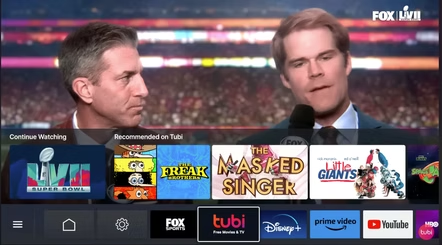
As an advertising agency, like so many of you, we love to watch the ads. There are always winners who got a bargain for the money they spent